

Justice Ezri of the Tax Court discusses my Article in McCague v. His Majesty The King
I recently achieved a professional milestone when, for the first time, a Tax Court of Canada Judge quoted and discussed my writing in one of their rulings. Reviewing this case and my article serve as an important reminder to CPAs that, when advising a shareholder on remuneration strategy, claiming a dividend—as opposed to drawing a salary—can make a shareholder personally liable for any unpaid income tax debts of the corporation.
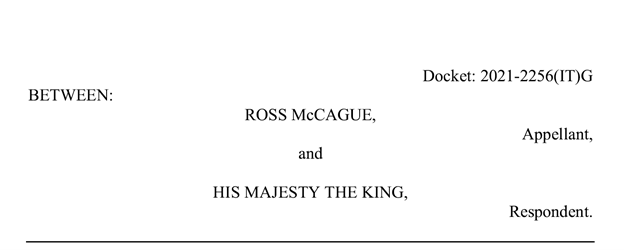
In McCague v. His Majesty The King, Justice Ezri had to decide whether the CRA was entitled to assess a 50% shareholder for his corporation’s unpaid income tax. Typically, the CRA can only pursue individuals for a corporation’s tax debts by using the director’s liability provisions to collect unpaid trust funds (i.e., GST/HST or source deductions). There is no director’s liability for unpaid income tax. However, in some cases, the CRA can use section 160 of the Income Tax Act to pursue a shareholder for a corporation’s unpaid income tax.
Section 160 essentially prevents retroactive creditor-proofing. It is the same provision that prevents a tax debtor from transferring their share of their matrimonial home to their spouse as soon as the CRA reassesses them in an attempt to shield the asset from collections actions. In such a case, section 160 allows the CRA to assess the spouse for the debtor’s tax debt, up to the value of the interest transferred.
In the corporate income tax context, section 160 allows the CRA to assess a shareholder for their corporation’s unpaid income tax if the shareholder received dividends during a year in which the corporation later turned out to owe tax. The CRA can assess the shareholder up to the value of the dividend they received. In practice, shareholders often do not know the corporation owed income tax in the relevant year until after an audit and reassessment.
A crucial condition for section 160 to apply in these circumstances is that the shareholder must be operating at non-arm’s length with the corporation. The CRA cannot pursue every shareholder who received dividends. Otherwise, anyone investing in public companies could be liable for those corporations’ unpaid income tax.
Paragraph 251(1)(c) and the Supreme Court’s decision in McLarty v. R. establish that two parties are not dealing at arm’s length when they are not acting independently and one exercises influence or control over the other.
This raises the question: when is a shareholder acting at non-arm’s length with a corporation whose shares they hold? More specifically, are two 50/50 shareholders—neither of whom can control the corporation independently—acting at arm’s length when they declare a dividend? If they are not dealing at arm’s length, the CRA can assess them under section 160. If they are, they are not liable.
This was precisely the issue facing one of my clients in 2021. I argued to the appeals officer that a 50% shareholder could be acting at arm’s length with the corporation depending on the specific facts. In my client’s case, the other 50% shareholder was misleading him about the corporation’s finances, lying to the CRA, and stealing corporate funds. The appeals officer maintained that a 50% shareholder is never at arm’s length.
Unfortunately, the appeals officer relied on HLB Smith Holdings Limited v. The Queen, where the Tax Court held that 50% shareholders are inherently not dealing at arm’s length with their corporation when declaring a dividend.
Relying on that decision, the appeals officer refused to consider that section 160 should not apply to my client. Given the amount at issue and the cost of disputing it further, my client decided not to proceed.
Frustrated with the outcome, I wrote an article for the Canadian Tax Foundation titled Paying Dividends to 50 Percent Shareholders: Can That Trigger a Section 160 Liability? in which I respectfully critiqued HLB Smith and endorsed an earlier decision suggesting that, absent special circumstances, 50/50 shareholders should be presumed to operate at arm’s length. I then tried to put the matter behind me.
Three years later, I received an email from David Sherman, editor of the Practitioner’s Income Tax Act, informing me that Justice Ezri had analyzed my article in McCague. Coincidentally, I had recently met Justice Ezri at the ceremony appointing Justice St-Hilaire as Chief Justice of the Tax Court.
In examining Mr. McCague’s circumstances, Justice Ezri devoted several paragraphs to my article and its relationship to the jurisprudence. He noted that “Mr. Blachford expressed concern that Smith ‘…concludes that 50 percent shareholders are inherently not dealing at arm’s length with their corporation when they decide to declare a dividend’…”
Ultimately, Justice Ezri reached the very conclusion I had urged upon the appeals officer years earlier:
61. The problem that I think both the courts and commentators are wrestling with is the need to avoid an outcome that ignores the facts in favour of a binary approach whereby the impugned dividend is somehow always the result a non-arm’s length arrangement or never the result of a non-arm’s length arrangement. The jurisprudence is clear that the factual arm’s length question is supposed to be determined as a question of fact. So, neither this Court in all of the cases discussed, nor the CTF commentators, endorse the proposition that every 50-50 shareholding case must be reflexively adjudicated as a non-arm’s length arrangement without any scrutiny of the circumstances. Likewise, a 50-50 arrangement to declare and pay a dividend, cannot simply be automatically discounted as being the product of an arm’s length arrangement.
In short, whether a 50% shareholder is operating at arm’s length with their corporation is a fact-dependent inquiry.